
Trust Reviews X may earn a commission when you buy through links on this page, at no extra cost to you. This does not affect our ratings.
Anyone weighing the customer io pros and cons is usually a product-led team looking for automation that reacts to what people actually do inside the product. At Trust Reviews X, we study how messaging platforms manage lifecycle communication so teams spend their technology budget wisely. Understanding these operational tradeoffs helps you pick a platform that matches your engineering capacity and campaign goals.
Customer.io is an event-driven engagement platform that sends targeted emails, push notifications and in-app messages based on user behavior. Companies adopt this category to connect their transactional databases with marketing workflows, swapping static list-based newsletters for behavior-based journeys.
Our quick verdict score for Customer.io is 8.1/10. It suits technical marketers and product teams who need lifecycle messaging driven by first-party behavioral data. It is less suitable for non-technical teams that want plug-and-play template libraries, or for organizations with simple, static newsletter needs.
| Evaluation Metric | Assessment Summary |
|---|---|
| Trustreviewsx score | 8.1/10 |
| Best for | Teams that need event-driven workflows tied directly to product data streams |
| Not ideal for | Organizations wanting basic newsletter builders without technical data integration |
| Key strengths | Behavioral event triggers, visual journey orchestration, multi-channel customer communication |
| What to check before buying | Review event storage limits, message volume thresholds and workspace permissions on the official Customer.io pricing page |
1. How Trustreviewsx Reviewed Customer.io
This review examines what Customer.io is built to do, who it serves and how it stacks up against similar tools. We applied seven Trustreviewsx criteria: features, ease of use, pricing and value, integrations, audience fit, support and competitive position. Plans, prices and limits change frequently, so we flag what you should verify on the official website before purchasing. This article was researched and drafted with AI assistance, then reviewed and edited by the Trustreviewsx Editorial Team.
2. Quick Summary of the Customer.io Pros and Cons
Looking at the customer io pros and cons reveals a messaging engine designed for companies that treat behavioral data as the core of user communication. The platform is strong at turning product activity into timely touchpoints across several channels. Teams without developers or data engineers, however, may hit configuration hurdles before they see value.
Lifecycle messaging works best when updates go out on time without manual effort. Before committing to a subscription, buyers should weigh the platform's data orchestration power against their internal capacity to implement it.
3. Core Pros of Using Customer.io

3.1. Behavioral Data and Event-Driven Triggers
Customer.io organizes campaigns around individual user events instead of broad mailing lists. When a customer completes an action in an application, such as creating a workspace or abandoning onboarding, the platform can send a targeted message right away. This event-centric approach means messages arrive while the context is still fresh for the recipient.
For technology companies and subscription services, event-based messaging keeps communication tied to real product usage. Because triggers can rely on custom behavioral attributes, marketers can build journeys that adapt to each customer milestone.
3.2. Visual Journey Orchestration
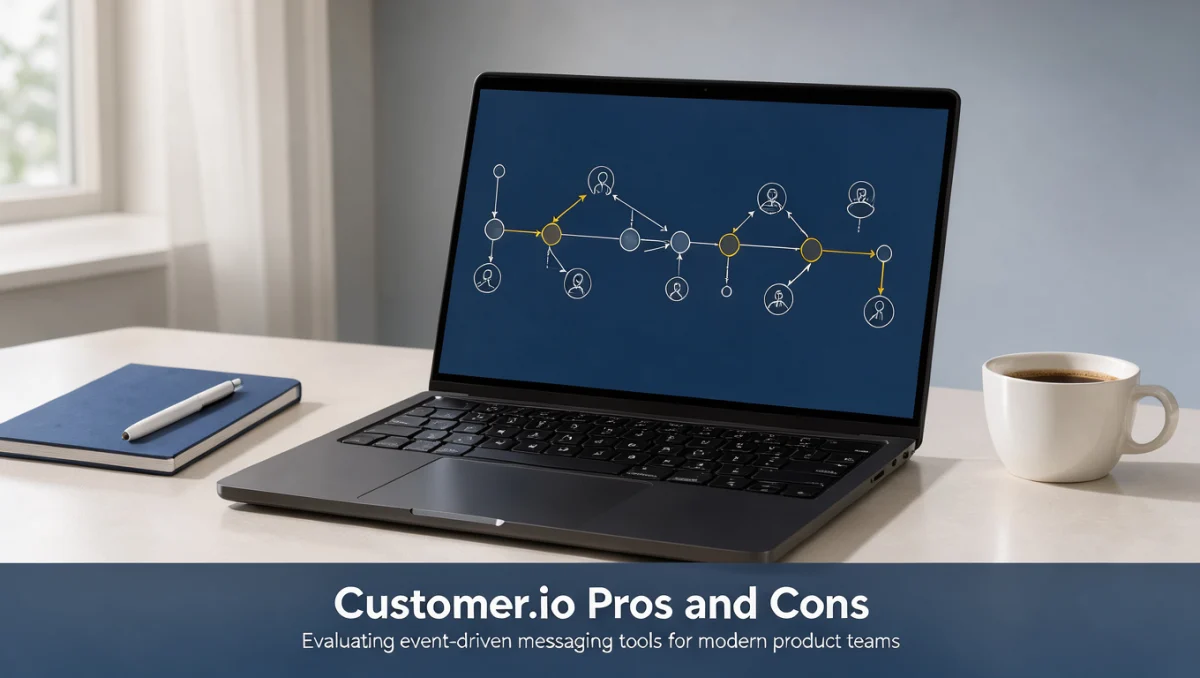
The visual workflow builder lets marketers map branching paths based on customer interactions and attributes. Teams can add delays, conditional splits and wait conditions that hold delivery until specific criteria are met. This granular control helps avoid message fatigue and keeps automated sequences feeling coordinated rather than repetitive.
Workflow design in engagement platforms works best when multiple channels interact logically. Customer.io lets operators combine email, mobile push, SMS and in-app messages on a single canvas, preserving one consistent narrative across devices.
3.3. Advanced Audience Segmentation Logic
Audience segments in Customer.io update dynamically as incoming data reflects user behavior. Segment rules can mix historical activity, current account properties and real-time event frequency. Once set up, segments refresh automatically, lowering the risk of sending outdated promotions to churned or already converted accounts.
Effective audience management needs clear boundaries. Teams running several brands or separate customer databases can use workspaces to separate data models, permissions and messaging assets across business units.
3.4. Multi-Channel Communication Variety
Modern customer retention depends on coordinating touchpoints beyond the email inbox. Customer.io supports cross-channel delivery, so teams can send push notifications, transactional alerts and in-app banners from one automation engine. This reduces tool silos and gives a coherent customer record across channels.
Linking support communication with a broader Customer Service infrastructure keeps customer interactions consistent across support tickets and lifecycle campaigns.
4. Core Cons and Operational Considerations

4.1. Technical Learning Curve for Setup
Customer.io requires working knowledge of data schemas, JSON payloads and event tracking calls. Marketing teams without dedicated technical support may struggle during implementation when configuring user attributes and tracking snippets. Non-technical staff often need help from engineering colleagues to establish clean data flow.
To ease this, organizations should allocate developer time during rollout to define consistent event naming conventions and payload structures before building end-user campaigns.
4.2. Template Design Workflow Constraints
Although the platform includes visual email builders and code editors, organizations looking for large collections of pre-made marketing templates may find fewer ready-made creative assets than in standard consumer marketing tools. Teams that prioritize design variety often need to build their own HTML templates or maintain an external design system.
Buyers should confirm template customization options on the official Customer.io website to make sure the editing tools match the skills of internal creative staff.
4.3. Subscription Scaling Considerations
Messaging platform pricing across the industry generally scales with profile volume and message throughput. As an organization grows its active subscriber base or raises event frequency, software costs can climb quickly. Organizations that keep large archives of dormant contacts may face higher costs unless they practice regular database hygiene.
Prospective buyers should review profile count thresholds and workspace add-on policies on the official Customer.io pricing page before signing a contract.
5. Summary Comparison of Strengths and Limitations
| Operational Dimension | Key Strength | Potential Tradeoff | Actionable Mitigation |
|---|---|---|---|
| Data Integration | Real-time event capture and custom attribute tracking | Requires developer support for tracking setup | Define tracking specifications before launching campaigns |
| Campaign Design | Flexible visual branch logic and multi-channel journeys | Complex workflow logic demands thorough testing | Run test cohorts before activating production journeys |
| Creative Production | Support for code-level customization and visual builders | Fewer pre-built creative layouts for non-designers | Build a standardized internal email design library |
| Audience Modeling | Dynamic, self-refreshing behavioral segments | Complex segment filters can confuse new team members | Document audience naming conventions internally |
| Channel Coverage | Centralized coordination of email, push and in-app channels | Delivery performance depends on clean credential setup | Verify sending domain records and mobile credentials early |
6. Who Should Choose Customer.io and Who Should Look Elsewhere
6.1. Product-Led Growth Companies
Software businesses that rely on in-app adoption metrics benefit significantly from Customer.io. Because communication triggers fire directly from user behavior, product teams can guide accounts through activation, feature discovery and renewal sequences tied to precise usage milestones.
6.2. Technical Growth Marketers
Marketers who are comfortable working alongside engineers and handling structured data will find the platform highly adaptable. Growth practitioners who value logic-driven experimentation, conditional branching and precise audience filtering can build sophisticated behavioral messaging loops.
6.3. Small Businesses with Basic Newsletter Needs
Organizations whose communication consists mainly of occasional monthly announcements or static newsletters may find Customer.io overly complex. Simple list-based email providers often offer faster setup and simpler interfaces for straightforward editorial publishing.
6.4. Teams Lacking Engineering Support
Marketing departments without technical assistance or developer access should weigh implementation requirements carefully. Without internal resources to set up event tracking pipelines, marketing teams may be slow to realize the platform's full value.
7. Frequently Asked Questions
7.1. What should teams review before choosing between event-based and list-based tools?
Teams should assess whether their communication strategy depends on real-time customer actions or on broad calendar-driven announcements. Event-based tools require clean product tracking data, while list-based platforms prioritize quick visual layout creation and simple contact uploads.
7.2. How can organizations prepare internal data before deployment?
Organizations should audit their current event tracking setup and agree on consistent naming conventions for user actions. Defining clear schemas for customer attributes and event parameters before account setup speeds onboarding and prevents duplicated data.
7.3. What ongoing maintenance do messaging platforms require?
Messaging software needs regular database cleanup to archive inactive profiles, routine audits of campaign branching logic and ongoing monitoring of domain sending authentication. Regular reviews prevent unexpected profile count increases and protect inbox placement.
7.4. Which internal roles should take part in evaluating Customer.io?
Evaluation teams should include product managers, growth marketers and software engineers. Marketers assess journey orchestration and creative workflows, while technical staff review event ingestion, API specifications and database compatibility.
8. Final Verdict on Customer.io
Customer.io is a capable choice for organizations that prioritize event-driven messaging, behavior-based segmentation and coordinated multi-channel workflows. Non-technical teams may face an initial learning curve, but organizations with solid data discipline can deploy highly responsive customer journeys.
| Evaluation Criterion | Score /10 | Reason |
|---|---|---|
| Features | 8.8/10 | Event-driven triggers, visual journey orchestration and dynamic audience segmentation deliver solid automation capability. |
| Ease of Use | 7.2/10 | The interface is logical, but initial setup requires understanding data schemas and technical event structures. |
| Pricing and Value | 7.5/10 | Buyers must monitor profile tiers and volume limits on the official pricing page to keep costs efficient over time. |
| Integrations | 8.0/10 | Data pipelines connect well with customer data platforms, though teams should confirm technical compatibility before purchase. |
| Audience Fit | 8.6/10 | Suits product-led businesses and technical marketing teams focused on behavior-driven engagement. |
| Support | 7.8/10 | Prospective buyers should review official support response tiers and technical documentation availability. |
| Competitive Position | 8.8/10 | Holds a distinct position among lifecycle automation tools by focusing on behavioral product events. |
Our overall score for Customer.io is 8.1/10. Product-led companies with engineering support will find the platform well suited to behavioral lifecycle marketing, while teams that only need simple newsletter delivery should consider simpler alternatives.
For more questions about software selection, contact our team at https://trustreviewsx.com/contact/ or follow Trustreviewsx on LinkedIn at https://www.linkedin.com/company/trustreviewsx/.
See More Review Craft X